
Time
Ask a vector store "who works on the billing migration?" and it returns the passages that sound most like the question. The January note that says Ravi joined, and the June retro that says he left, both sound like the question. The store has no idea that one replaced the other. Your agent gets both, with nothing to tell them apart, and answers with whichever the model happened to read first.
Time is where memory for agents most often fails, and where RememberStack does the most work. Every fact knows when it was true in the world. Every claim knows when its source said it. Every fact knows when the memory learned it and when the memory stopped believing it. And every query says which time it is asking about.
Three clocks
RememberStack keeps three separate clocks. Mixing them up is the most common source of wrong answers about time, so they never share a field.
| Clock | Question it answers | Fields |
|---|---|---|
| World time (valid time) | When was this true, or when did it happen? | Facts: valid_from, valid_until, valid_precision. Claims: claim_valid_from, claim_valid_until, claim_valid_precision, claim_valid_kind. |
| Said-on time | When did the source say it? | Claims: asserted_at. |
| Belief time (system time) | When did the memory learn it, and when did it stop believing it? | Facts: ingested_at, invalidated_at. |
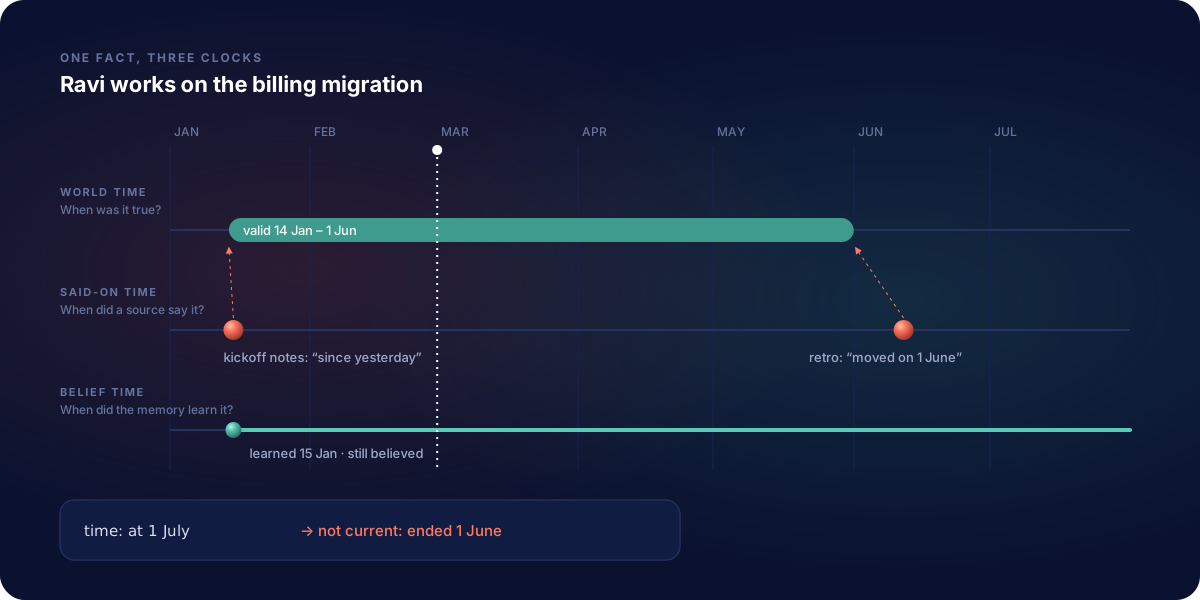
A worked example makes the difference concrete. The team's notes contain two documents:
- Kickoff notes, ingested with
source_modified_at2026-01-15 10:00 UTC: "Ravi has been on the billing migration since yesterday." - Retro notes, ingested with
source_modified_at2026-06-12 14:00 UTC: "Ravi moved from the billing migration to the search team on 1 June."
For the fact "Ravi works on billing migration", the three clocks read:
| Clock | Value | Where it came from |
|---|---|---|
| World time | from 2026-01-14 until 2026-06-01 | "since yesterday", resolved against the kickoff date; closed by the retro's "on 1 June" |
| Said-on time | 2026-01-15 (kickoff claim), 2026-06-12 (retro claim) | each document's source_modified_at |
| Belief time | learned 2026-01-15, a few minutes after ingest; still believed | when the pipeline wrote the fact; no retraction since |
Notice what the retro did not do. It did not end the fact on 12 June, the day the retro was written. Said-on time is provenance, never validity. The fact ends on 1 June because that is when the retro says the move happened.
World time on claims
Every claim carries the world time its source stated, if any, as four fields:
claim_valid_fromandclaim_valid_until: the stated bounds.claim_valid_precision: how exact they are (see Precision).claim_valid_kind: what the bounds describe:
| Kind | Meaning | Example |
|---|---|---|
event_time | When something happened. | "Ravi merged the schema change on 2026-03-03." |
effective_period | When a state or arrangement applied. | "Ravi worked on the billing migration from January to May." |
measurement_period | The period a figure covers. | "Q1 billing errors fell to 12." |
proposition_validity | When a proposition holds. | "Dana has led product since 2024." |
Most claims state no world time. They keep unknown precision and empty
bounds. RememberStack never falls back to the said-on time or the ingest
time to fill the gap; an undated statement stays undated.
Relative dates are resolved. When a source says "yesterday", "last
Friday" or "last year" and the document has a date, the extractor resolves
the expression and writes the absolute date into both the structured fields
and the claim text: "since yesterday" in a note dated 2026-01-15 becomes
"since 2026-01-14". The original wording stays in source_span. When there
is no date to resolve against, or the expression is too vague ("a few weeks
ago"), the wording is kept as spoken and no date is invented. A relative
phrase still present in claim_text is itself the signal: read it against
asserted_at.
The document date comes from source_modified_at when you ingest. Set it,
especially for transcripts and chat logs, where "yesterday" is common. See
Documents, versions and sources.
Claim times never change. Two sources may state different, even conflicting, windows for the same thing; both stand as evidence.
World time on facts
Each fact has one chosen world-time window: valid_from,
valid_until and valid_precision, returned together in the fact's
validity. Unlike a claim's window, a fact's window changes as evidence
arrives:
- A new fact takes the window of the claim it came from, but only when that window describes this particular assertion. A claim that mentions a 2019 hire and a 1990 founding does not give both facts the same dates.
- A later claim can correct the dates ("the cutover was 9 June, not 8 June"). The fact keeps its identity; its window is replaced, and the decision names the claims that justify it.
- A successor closes its predecessor. Ravi's move to the search team caps "Ravi works on billing migration" at 2026-06-01, the successor's start in the world.
Each change is written to the fact's decision transcript with the window before and after. See Evidence.
Precision
Precision says how exact a window is. It is never faked: a claim that says "in 2025" is a year, not 1 January 2025.
| Precision | Meaning | Example |
|---|---|---|
instant | An exact moment. | "the deploy finished at 16:30 UTC" |
day | A calendar day. | "on 2026-06-01" |
month | A calendar month. | "in March 2026" |
quarter | A calendar quarter. | "in Q2 2026" |
year | A calendar year. | "in 2025" |
open | A known start, still ongoing. | "since 2026-01-14" |
unknown | No usable date. | "Ravi is the on-call engineer" |
Claim ends are inclusive; fact ends are exclusive
A claim stores the bounds as the source stated them, with an inclusive
end: "in 2025" is claim_valid_from 2025-01-01, claim_valid_until
2025-12-31, precision year. A fact stores the canonical interval with
an exclusive end: valid_from 2025-01-01T00:00:00Z, valid_until
2026-01-01T00:00:00Z. A day-precision fact for 2026-06-01 ends at
2026-06-02T00:00:00Z. Compare fact bounds with valid_from <= t < valid_until.
A fact's window may also be partly known: a start without an end (and not
open), or an end without a start. Partial windows are kept as they are,
never completed with an invented date.
Asking about time
facts_context and combined_context take a time argument that selects
which facts count, by their world-time window. There are four modes.
| Mode | Returns facts that… | Use it for |
|---|---|---|
current (default) | are true now: start at or before now, and end after now or have no end. | "Who works on the billing migration?" |
at | were true at one instant at. | "Who worked on it on 1 March?" |
overlap | overlap the inclusive range from–to. | "Who worked on it in May and June?" |
history | began at or before now, whether or not they have ended. | "Who has ever worked on it?" |
import remember

with remember.Client() as memory:
    now = memory.facts_context("who works on the billing migration")
    march = memory.facts_context(
        "who works on the billing migration",
        time={"mode": "at", "at": "2026-03-01T00:00:00Z"},
    )
    summer = memory.facts_context(
        "who works on the billing migration",
        time={"mode": "overlap", "from": "2026-05-15T00:00:00Z", "to": "2026-06-15T00:00:00Z"},
    )
    ever = memory.facts_context(
        "who works on the billing migration",
        time={"mode": "history"},
    )
Instants must carry a timezone. The mode you asked for comes back in the
result's temporal_scope, with the instant the query was evaluated
(evaluated_at), so an answer always states the time it describes. See
Reading a result.
All four modes read current belief: only facts the memory believes now
(invalidated_at is empty) are returned.
Confirmed and possible
A fact with no dates, or with only one known end, cannot be ruled in or out
by a time filter. RememberStack does not drop it and does not pretend it
matches. It returns it with temporal_match: "possible".
temporal_match | Meaning |
|---|---|
confirmed | The fact's window is complete (both ends known, or a known start that is open), so the match is established. |
possible | The window is missing or partial. The fact passed the filter because nothing rules it out, not because its dates match. |
Your agent should treat a possible fact as a lead, not an answer, when the
question is about time.
The worked example, queried
Add a third fact with no date, "Ravi is the on-call engineer for billing incidents". Evaluated on 2026-09-23, the modes return:
| Query | Ravi works on billing migration (2026-01-14 to 2026-06-01) | Ravi works on search team (since 2026-06-01, open) | Ravi is on-call (no date) |
|---|---|---|---|
current | not returned (ended) | confirmed | possible |
at 2026-03-01 | confirmed | not returned (not started) | possible |
overlap 2026-05-15 to 2026-06-15 | confirmed | confirmed | possible |
history | confirmed | confirmed | possible |
A vector search over the same notes has one mode: similar text. It returns the kickoff line and the retro line side by side in every case.
Belief time and "as of"
ingested_at is when the memory first held a fact. invalidated_at is when
it stopped believing it, for example because a living source removed the
fact's only support (see Updating a source). Facts
are never deleted by this: an invalidated fact stays in memory with the
instant it ended.
The graph operations take both clocks together, for a two-axis question:
"what did the memory believe on believed_at about the world on
valid_at?"
from datetime import datetime, UTC

import remember

with remember.Client() as memory:
    ravi = memory.resolve_entity("Ravi").entities[0]
    before_the_retro = memory.graph_neighborhood(
        entity_id=ravi.entity_id,
        valid_at=datetime(2026, 5, 1, tzinfo=UTC),
        believed_at=datetime(2026, 6, 1, tzinfo=UTC),
    )
valid_at and believed_at must be given together or not at all. The
result's temporal_scope has mode as_of and names both. See
Graph.
Note
A fact's window is corrected in place. A believed_at read filters on
ingested_at and invalidated_at, and shows each fact with its window
as it stands today. The windows a fact had before a correction are kept
in its decision transcript, not replayed by the read.
Time on claims and passages
The claims-and-sources side of memory answers "what did the sources say?",
and there the said-on time is what matters. Every evidence result carries
asserted_at and the claim's own world-time fields; every passage
(ChunkEvidenceResult) carries its version's source_modified_at.
To ask what sources asserted about a period, the examples.claims_as_of
saved query returns the claims whose stated window overlaps the range you
give it. Claims with unknown precision cannot match a window; the query
leaves them out and reports how many there are in its
unknown_precision_excluded column, so an empty answer is never mistaken
for "nothing was said". See Saved queries
and Ask about the past.
Where to go next
- Ask about the past: recipes for point-in-time and period questions.
- Facts: how windows are chosen and corrected.
- Reading a result:
validity,temporal_matchandtemporal_scopefield by field. - Assured operations: the
timeargument schema.