
Claims: what a source said
Most memory systems hand your agent a text chunk and let the model work out what it means. The chunk says "he agreed to move it to June". Who agreed? Move what? Which June? The agent guesses, or asks you again.
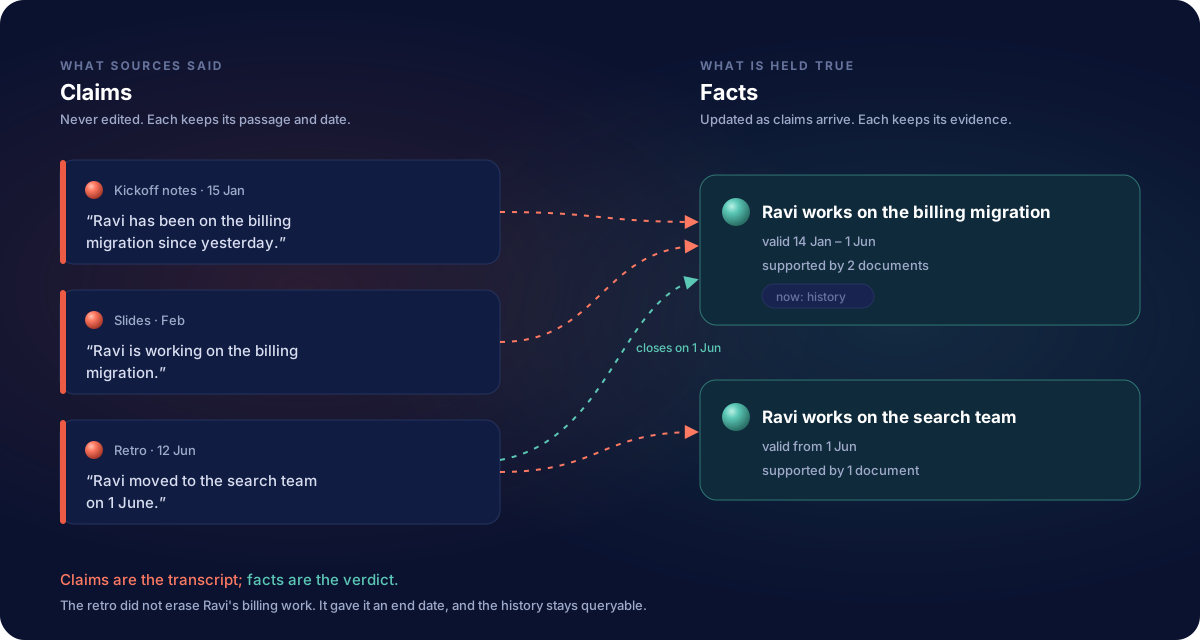
RememberStack does that reading once, at write time. It turns each document into claims: short statements that stand on their own, each tied to the exact characters of the source that support it. A claim records what a source said, not whether it is true. Deciding what is true is the job of facts. Claims are the transcript; facts are the verdict.
What a claim is
A claim is one coherent assertion from one document version, rewritten so a reader needs no surrounding context. From a meeting transcript dated 2026-03-04:
Ravi: Dana and I agreed yesterday to move the cutover to June 8.
RememberStack might store:
| Field | Value |
|---|---|
claim_text | Ravi said that Dana and Ravi agreed on 2026-03-03 to move the billing migration cutover to June 8. |
source_span | Dana and I agreed yesterday to move the cutover to June 8. |
is_attributed | true |
asserted_at | 2026-03-04T15:00:00Z |
The claim resolves pronouns ("I" becomes Ravi), partial references ("the
cutover" becomes the billing migration cutover, when the document says so)
and relative dates ("yesterday" becomes 2026-03-03 when the document carries a
date). The original wording is kept in source_span.
A claim keeps an assertion together even when its support spans several sentences, and keeps apart things that differ: independently dated events, statements by different speakers, and propositions that sound alike but are not. "Ravi finished the migration", "Ravi worked on the migration" and "Ravi enjoyed the migration" are three different claims.
Every claim carries:
claim_id,doc_idandchunk_id(the passage it came from),claim_textandsource_span,char_startandchar_end, the origin span in the version's converted text, andevidence_spans, every span that supports it (see Evidence),is_attributed(see below),asserted_at, when the source said it,claim_valid_from,claim_valid_until,claim_valid_precisionandclaim_valid_kind, when the claim says it happened or was true (see Time),is_current_testimony(see below).
How claims are made
Extraction runs two model calls per chunk, in two pipeline stages.
1. Selection: what is worth keeping
The first call, Selection, reads a chunk with its surrounding context
and judges every statement in it. Each candidate gets exactly one outcome:
keep, keep_flagged (kept, but marked borderline), or a drop with a named
reason. The drop reasons are a fixed list:
| Reason | What it drops |
|---|---|
opinion | An unattributed opinion ("this approach is cleaner"). |
advice | Advice or recommendations ("you should back up first"). |
hypothetical | Hypotheticals ("if we delayed, costs would rise"). |
generic | Generic truisms ("migrations are risky"). |
question | Questions. |
intro | Section introductions ("this section covers…"). |
conclusion | Section conclusions and wrap-ups. |
no_info | Statements that say nothing is known ("we don't know yet"). |
ambiguous | Statements whose meaning the source leaves open. |
references_boilerplate | Reference lists and boilerplate. |
Selection keeps specific, checkable assertions about events, states,
decisions, quantities, policies and relationships, including quantities,
dates and changes of state phrased as opinions. When unsure, it prefers
keep_flagged to a drop.
An opinion with a holder is kept. "Dana thinks the June date is too tight" is a claim about Dana's stance, not an assertion that the date is too tight.
Selection also notes the people, companies, works and events the chunk introduces, so later chunks of the same document can refer back to them.
2. Claimify: make each statement stand alone
The second call, Claimify, rewrites each kept statement into a standalone claim (decontextualise), splits unrelated assertions apart (decompose), and cites the passages that support it. It may only use the document itself: the header, the target chunk, permitted neighbouring passages and the quoted passages of earlier references. It never uses outside knowledge. If the source leaves several readings possible, the candidate is omitted.
Every piece of text Claimify adds from outside the target chunk is listed in
the claim's added_context, tagged with where it came from.
3. The grounding gate: no text without a source
Before a claim is stored, a deterministic check (no model involved) verifies it:
- Every cited passage must exist. The first, the origin, must lie in the target chunk and overlap a statement Selection kept.
- Every word Claimify added must occur in the document's permitted context. Numbers get no exception, except an ISO date the claim itself resolved and also recorded in its structured time fields.
A claim that fails is not stored. RememberStack does not ask the model to try again; it drops the candidate and records why.
The model also returns its own judgement of whether the source supports the
whole claim (entailment_self_verdict). It is stored for audit but does not
decide anything: a matching word is not proof of meaning, and the engine
does not pretend otherwise.
The audit ledger
Every decision along the way is written to an append-only ledger, one row per decision:
| Decision type | Recorded when |
|---|---|
selection_drop | Selection dropped a statement (with its reason). |
selection_keep_flagged | Selection kept a borderline statement. |
decontext_edit | Claimify added context to a statement. |
claimify_omitted | Claimify left out a kept statement. |
grounding_rejected | The grounding gate refused a claim (with the check that failed). |
So "why is this sentence not in memory?" has a recorded answer. The
ledger lives in the deployment's PostgreSQL database. It is not yet exposed
through the HTTP API, the SDK or the memory_v1 query space.
Claims never change
A claim is immutable. Nothing edits its text, its dates or its source after it is written. If a later source contradicts it, that is a new claim from a new source. If the extractor improves and reads the same file differently, that produces new claims, and the old ones remain as history.
This is what keeps provenance honest. A claim is testimony: this source, in this version, said this. Belief can change; testimony does not. The part that changes when evidence changes is the fact.
When a new version of a document keeps a passage unchanged, RememberStack
does not extract it again: the unchanged passage keeps its existing claims,
with the same claim_id. The cost of a new version grows with the size of
the edit, not the size of the document.
Attributed claims
is_attributed is true when the claim records someone's statement or
stance rather than asserting something directly: "Ravi said the cutover
moved", "Dana believes June is too tight".
Attribution is never dropped. "Ravi said he finished the migration" does not become "Ravi finished the migration". When the claim becomes a fact, an attributed claim becomes an observation about the speaker's stance, not a fact about the subject (see Facts).
Current and superseded testimony
is_current_testimony says whether a claim still counts as what its source
currently says. It starts true. It becomes false when:
| Reason | What happened |
|---|---|
reextracted | A newer extractor processed the same file; its claims replace these. |
version_superseded | In living mode, a new version of the document no longer contains this passage. |
version_deleted | The version was deleted. |
A fourth reason, review_restored, returns a claim to current testimony.
Currency is bookkeeping, not truth. A non-current claim still exists, can
still be read for audit, and still says what it said. What changes is that it
no longer counts as support for a fact. In snapshot mode (the default) a
new version flips nothing: every version stays standing testimony. See
Updating a source.
The assured operations return current testimony only. Historical claims are
visible through the memory_v1 query space (claims_visible_history) for
audit.
Where to go next
- Facts: how claims become what memory holds true.
- Evidence: how a claim points back to the source text.
- Time: the dates a claim carries.
- Cite the source of an answer.