
The pipeline and readiness
RememberStack does its thinking when you write, not when you ask. Reading a document, splitting it into claims, resolving who is who and deciding what is true all happen once, in the background, after ingest. That is why a query can answer from settled facts without calling a language model, and why the same question gets the same answer twice.
The cost is that knowledge is not queryable the instant you send it. Processing a document takes minutes, not milliseconds. This page explains what happens in those minutes and how to know when it is done.
The stages
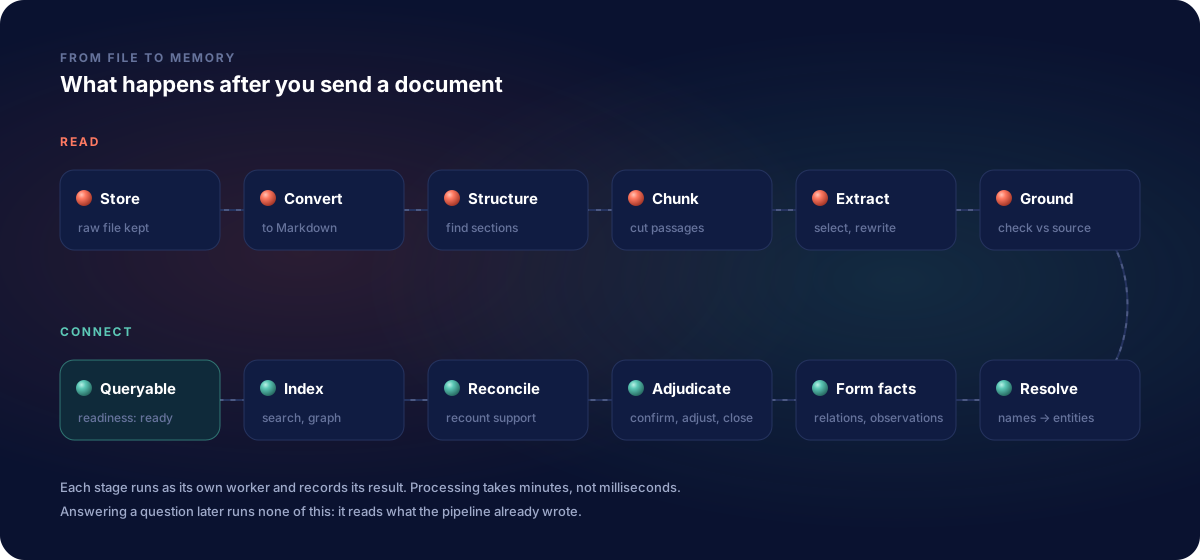
POST /ingest (or memory.ingest) returns as soon as the bytes are stored
and a version is recorded. Everything after that runs in workers, one stage
at a time, with some stages running in parallel:

| Stage | What it does | Uses a model |
|---|---|---|
ingest | Stores the bytes once per content hash and records a new version, or returns the existing one if the bytes are unchanged. Runs inside the API call. | No |
convert | Turns the file into Markdown text (document.md) and a grid of blocks. Text and office formats convert without a model; images are read with OCR and described by a vision model. | For images, and for OCR routes you configure |
structure | Finds the document's sections from its headings, gives each a role, and writes short section summaries used only for orientation. | Yes (roles and summaries) |
chunk | Cuts the text into chunks: non-overlapping runs of whole blocks. | No |
embed_chunk | Computes a vector for each chunk for semantic search. | Embedding model |
extract_claims | Selection, per chunk: decides which statements to keep and which to drop, with a reason. | Yes |
ground_claims | Claimify plus the grounding gate, per chunk, once every chunk has been through Selection: writes standalone claims and checks every one against the source. | Yes |
normalize_relations | Per claim: turns it into relations and observations, and resolves their entities. | Yes |
adjudicate_observations | Per entity: decides how each new assertion changes the facts (add, confirm, adjust, supersede, contradict). | Yes, when the entity already has facts |
adjudicate_supersession | Refreshes the profiles of entities whose facts changed, and re-examines their identity. | Yes (profiles) |
embed_claim | Computes a vector for each claim for semantic search. | Embedding model |
reconcile | Updates which claims are current testimony, recounts every affected fact's evidence, and retracts or flags facts that lost all support. | No |
label_relation | Writes each fact's readable label and computes its vector. | Embedding model |
The details of each step are in Claims, Facts, Entities and Updating a source.
When a new version of a document arrives, unchanged passages reuse their earlier work: their conversion, their claims and their vectors. Only what changed is processed again.
How long it takes
Expect minutes per document, and longer for large ones. Every model-backed stage waits on a provider, and some stages cannot start until every chunk or every claim of the version has finished the one before. The structure stage alone has been measured at about 11 minutes on a 2.5 KB file.
Plan for this. An agent that ingests a note and immediately asks about it will not find it. Write first, then wait for readiness before relying on the content.
No model on the read path
Once processing is done, reading is cheap and repeatable. The assured operations and retrieval primitives run on PostgreSQL and embedding search only. The one outside call a query may make is to embed the query text for semantic search. No language model rewrites, ranks or summarises your answer at read time.
Stage statuses
For each version and stage, readiness reports one status:
| Status | Meaning |
|---|---|
missing | No work for this stage exists yet, usually because an earlier stage has not finished. |
pending | Queued, waiting for a worker (or waiting to retry after a failure). |
running | A worker is on it. |
succeeded | Done. |
skipped | Nothing to do for this version. Counts as done. |
failed | The last attempt failed; it will be retried. |
dead_letter | It will not be retried automatically. |
Stages that fan out (per chunk, per claim, per entity) report one combined status for the whole version, so a version is never shown as done while part of it is still running.
Dead letters
A unit of work is dead-lettered when it has used up its attempts (three
by default) or fails with an error that retrying cannot fix. It stops there,
and so does everything after it for that version. Readiness shows the stage
as dead_letter.
A dead letter does not fix itself. When you see one, stop waiting and look at why. On a self-hosted deployment, see Operating the pipeline for how to inspect and replay it.
A file whose type has no configured converter is not dead-lettered. The
original is stored and its conversion waits, reported as pending, until a
route for that type exists.
Readiness
Readiness answers one question: can I recall this yet? You ask it for
one or more version_ids (up to 1,000 per call) and name which
capabilities you need. It reports each capability separately and a single
ready that is true only when every capability you required is ready.
| Capability | Ready when | What it makes possible |
|---|---|---|
pipeline | Every stage above has succeeded (or been skipped) for every version you asked about. | Claims and facts from those versions exist. |
p1 | The deployment's search indexes are built for all seven channels: semantic search over chunks, claims, relations, observations and entities, and BM25 keyword search over chunks and claims. | Search-backed operations can find them. This is deployment-wide, not per version. |
live_graph | The deployment's PostgreSQL graph passes its health checks. | Graph traversal and the neighbourhood expansion in facts_context. Deployment-wide. |
p3 | A filesystem snapshot of the corpus has been published after your versions finished. | The read-only filesystem views. Self-hosted only; see Filesystem views. |
For ordinary recall, require pipeline, p1 and live_graph, and leave
p3 off unless you read the filesystem views.
import remember

with remember.Client() as memory:
    version = memory.ingest(
        "notes/2026-04-28-standup.md",
        source_kind="notes",
        source_ref="notes/2026-04-28-standup.md",
    )
    report = memory.wait_for_readiness([version.version_id])
    print(report.ready)
wait_for_readiness requires pipeline, p1 and live_graph (add
require_p3=True for p3). It checks every 15 seconds for up to 30
minutes by default and raises TimeoutError when the time runs out. It
keeps waiting through a failed stage, which is being retried, and stops
at once with PipelineDeadLettered on a dead_letter stage. See
Wait until a document is queryable.
The report also carries build_revision and model_bindings: which engine
build and which models are processing your documents.
Note
A document's status (ready in GET /documents) is not readiness. A
document is ready once it is converted and structured; its claims and
facts come later. Use readiness to decide when to query.
Where to go next
- Wait until a document is queryable
- Ingest, readiness, documents:
POST /readiness. - Operating the pipeline (self-hosted).