What lives where
A RememberStack deployment is a small number of processes around one
PostgreSQL database and one object store. Knowing which piece holds what
tells you what to back up, what can be rebuilt, and why a search can miss
something new but never return something withdrawn. This page describes a
deployment as the shipped compose.yaml runs it.
The pieces
| Piece | What it does |
|---|---|
| PostgreSQL | Holds the memory: every document and version, every claim, entity and fact, the decisions that changed them, and the queue of pipeline work. The search indexes and the graph are in the same database. |
| Object storage | Holds files: the original bytes you sent, the Markdown converted from them, and filesystem-view snapshots. Any S3-compatible store; Compose runs SeaweedFS. |
| The API | One process that answers HTTP. Ingest stores the original and records a version; reads run against PostgreSQL. |
| The workers | One process per pipeline stage, from convert to label_relation. Each takes work from the queue in PostgreSQL, calls models where the stage needs one, and writes its results back. |
setup | Runs once before the others start: database migrations, buckets, the deployment record. |
| Model provider | Outside the deployment. Workers call it to read documents and compute vectors; the API calls it only to embed the text of a search. |
The remember package | On your machine: the CLI, the Python client and the MCP server. It talks to the API over HTTP and holds no memory of its own. |

Where each kind of data lives
An authority is the copy every answer is checked against. A derived copy is built from an authority to make something faster or easier, and it can fall behind.
| What | Where | Authority or derived |
|---|---|---|
| Documents, versions, source identity | PostgreSQL | Authority |
| Claims, and the passages they came from | PostgreSQL | Authority |
| Entities, aliases, merges | PostgreSQL | Authority |
| Facts (relations and observations), their time windows and evidence links | PostgreSQL | Authority |
| Decisions that changed a fact or an identity | PostgreSQL | Authority |
| Pipeline work: what ran, what failed, what waits | PostgreSQL | Authority |
| Model spend (the cost ledger) | PostgreSQL | Authority |
Search indexes: vectors (pgvector) and keyword ranking (BM25, pg_textsearch) | PostgreSQL | Derived. Written by the embedding and labelling stages after the rows they index. |
| The live graph | PostgreSQL property-graph definitions over the current tables | Neither: a view. It reads the tables themselves, so it cannot fall behind them. |
The query space memory_v1 for SQL queries | PostgreSQL views and functions | A read-only view of the authority. |
| Original files | Object storage, bucket remember-raw | Authority. Identical bytes are stored once. |
| Converted Markdown and the files produced with it | Object storage, bucket remember-artifacts | Derived from the original. Chunks point at positions in it, so it is kept, not rebuilt. |
| Filesystem-view snapshots | Object storage, bucket remember-corpusfs | Derived. Rebuilt on demand. |
The bucket names are the defaults of a Compose deployment. Everything in PostgreSQL and the first two buckets belongs together: back them up at the same moment (Upgrades and migrations).
Why everything is in one database
Claims, facts, their evidence, the search indexes and the graph share one PostgreSQL database, so there is no second store to keep in step, and a read can confirm its results against all of them in one consistent snapshot. The graph reads the current fact tables directly, so it never shows a relation those tables have already withdrawn.
Inside the database, the one thing that lags is the search index: vectors are computed after the
rows they describe, by later pipeline stages. Readiness reports this lag as
the p1 capability (The pipeline and readiness).
How a read uses the pieces
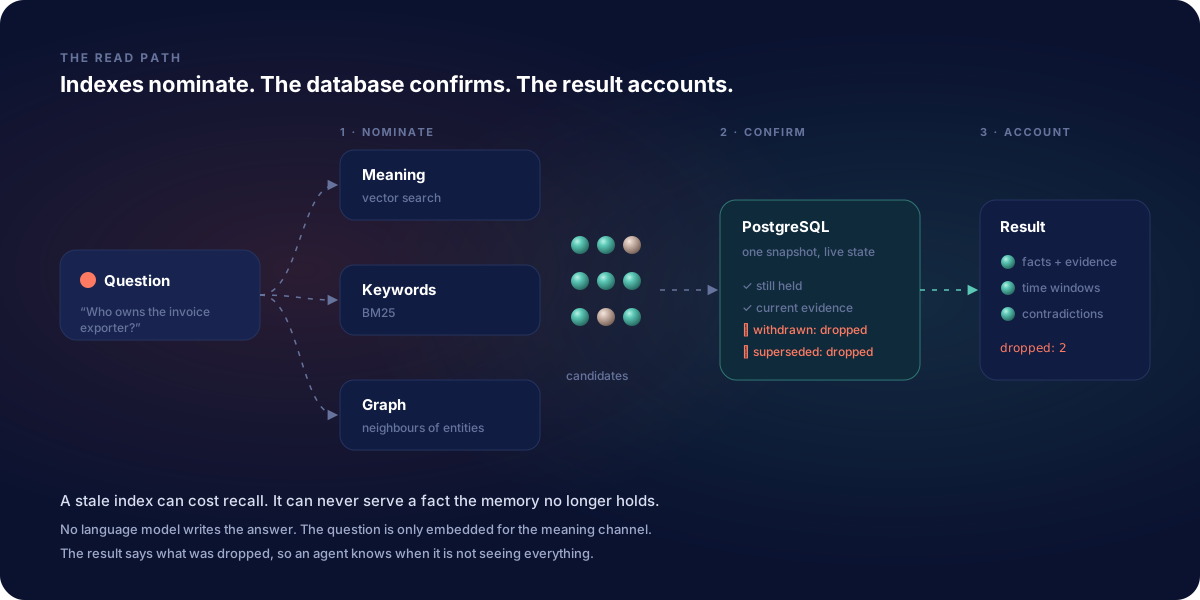
Every read that searches works in three steps:
- The search indexes nominate candidates. Vector and keyword search each propose the chunks, claims or facts that look relevant. This is fast, and it may be out of date.
- PostgreSQL confirms them. Every candidate is read again from the authority tables, all in one consistent snapshot. A candidate that no longer holds (a fact that was withdrawn or replaced, a claim that is no longer current, an entity merged into another, or one outside the time you asked about) is dropped.
- The result accounts for what was dropped. The count is in
dropped_by_hydration, so you can tell a short answer from a complete one.
The consequence: a stale index can cost recall, because something it has not indexed yet cannot be nominated. It cannot serve a withdrawn fact, because nothing reaches the answer without passing the check against the authority. No language model takes part in any of this; see Retrieval.
Where to go next
- The pipeline and readiness: what each worker produces.
- Retrieval: the operations, search, graph and SQL queries.
- Install with Docker Compose: the services and volumes of a self-hosted deployment.