Why RememberStack
RememberStack is a memory system for AI agents. Ingest documents into a structured spine and get back navigable, auditable knowledge: not just passages that look relevant, but an account of what sources said, what the system currently holds true, and how those two can differ.
Scale is a design requirement, not a slide: the system is built to stay useful at a million documents.
The default self-host profile routes Markdown conversion out of the box; additional MIME routes (HTML/PDF/media) are engine-supported but must be registered on the deployment. See Project status for what ships.
Why you should care
Most “memory” stacks answer: where did I read something like this?
Agents that act need a harder question: what do we actually know — and what changed our mind?
| Failure mode in typical RAG / memory | RememberStack response |
|---|---|
| Source text is treated as truth | Claims (testimony) are separate from facts (adjudicated current belief) |
| Edits overwrite history | Supersession closes a validity window; history stays queryable |
| Contradictions are averaged or hidden | Contradictions are grouped and returned together |
| Re-ingestion inflates confidence | Support counts distinct document lineages, not re-extracts |
| Vector index is the authority | Indexes nominate; Postgres confirms live validity |
| LLM completion on every query | No LLM completion on the query path (semantic search still embeds the query string) — planning stays in the agent |
| “No results” is a vague empty list | Typed negatives: unknown_entity, known_empty, boundary |
If your agent must act on memory — not just chat about a corpus — those distinctions are load-bearing.
The one mental model: three planes
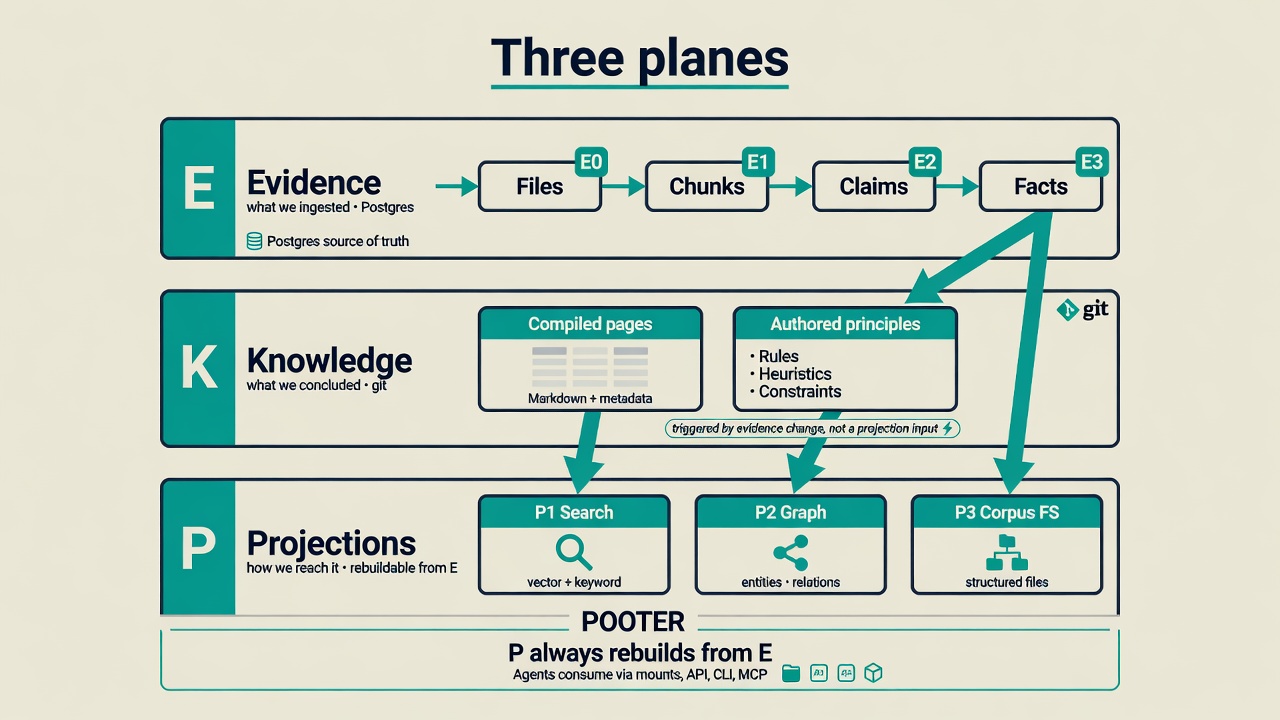
| Plane | Meaning | Authority | Rebuildable? |
|---|---|---|---|
| E — Evidence | What we ingested and adjudicated | Postgres (+ object storage for bytes) | No — it is the ground truth |
| K — Knowledge | What we concluded in prose | Git (compiled + authored pages) | Compiled pages recompile; authored pages are commitments |
| P — Projections | How we reach it fast | None — derived only | Yes — drop and rebuild anytime |
One line: E is what we ingested, K is what we concluded, P is how we reach it — and P always rebuilds from E.
Built for agents (primary), readable by humans
Primary consumers are agent harnesses (Claude Code, Codex, OpenCode, and peers). That is not marketing color; it drives the surface design:
- Filesystem-first. Four read-only mounts: corpus tree, converted artifacts, raw originals (off the nav path), Plane K checkout. Prefer
ls/ read /grepwhen mounts exist. - Query when files cannot. Semantic search, live graph traversal, time-travel, hydration, and open SQL — via API, CLI, and MCP with the same operations.
- Honest envelopes. Every assured answer declares grain, freshness, contradictions, truncation, and typed “no”s so the agent can reason about the answer. Wire shape is flat single-grain by default — see Envelope.
- Generated skill. Each deployment can render a versioned
SKILL.mdthat teaches the two-layer model and the four assured operations. Automated cold-agent checks guard that curriculum.
Humans get the same audit trail: every conclusion drills to claims, then to the exact span, page, image region, or second of audio.
Reading motion (do this every time)
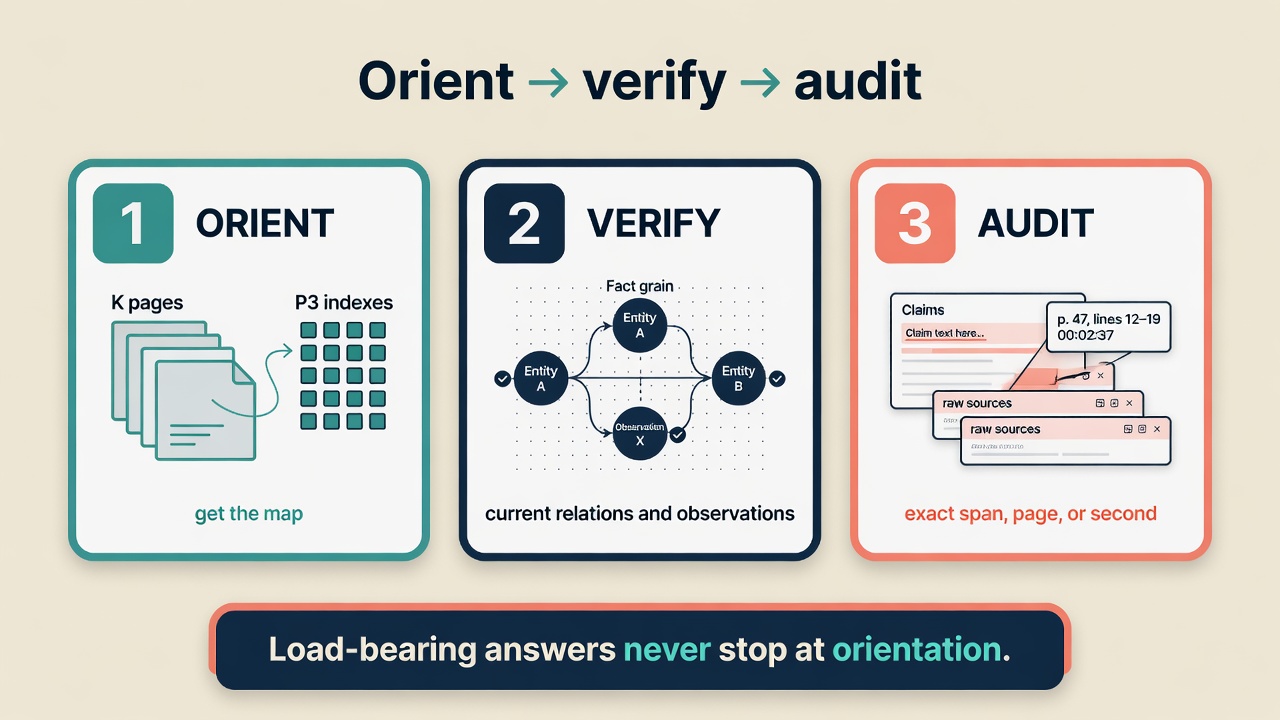
- Orient — K pages and P3 indexes for the map.
- Verify — fact grain (relations + observations) for anything load-bearing.
- Audit — claims and raw sources when stakes demand provenance.
Never stop at orientation for decisions that cost money, trust, or irreversible action.
Ship surface (what agents call today)
Exactly four top-level assured operations:
| Operation | Use for |
|---|---|
resolve_entity | Turn a name/string into ranked entity candidates |
claims_and_sources_context | High-recall evidence context (claims + chunks) for a question |
facts_context | Current or historical fact context with live testimony under budget |
combined_context | Both complete authority views in ContextBundle/v2 |
Plus open query: sandboxed SQL, typed live-graph helpers, saved examples.*
queries, and schema discovery. The helpers read PostgreSQL live; there is no
graph snapshot or public Cypher surface. Full contracts:
Retrieval, API.
Open source = full engine
Apache-2.0. Correctness-determining behavior — extraction, entity resolution, supersession, provenance, budgets, DLQ, hard-forget — is never paywalled. The hosted cloud runs this same engine; it adds operations and product chrome, not a secret core.
Next
| You want… | Go to |
|---|---|
| Run it in minutes | Getting started |
| Competitive brief vs passage RAG | vs passage RAG |
| Vocabulary (claim / fact / grain / clocks) | Concepts |
| End-to-end map | Architecture |
| How writes work | Ingestion |
| How reads work | Retrieval |
| Compiled knowledge pages | Knowledge (Plane K) |